Skip to content
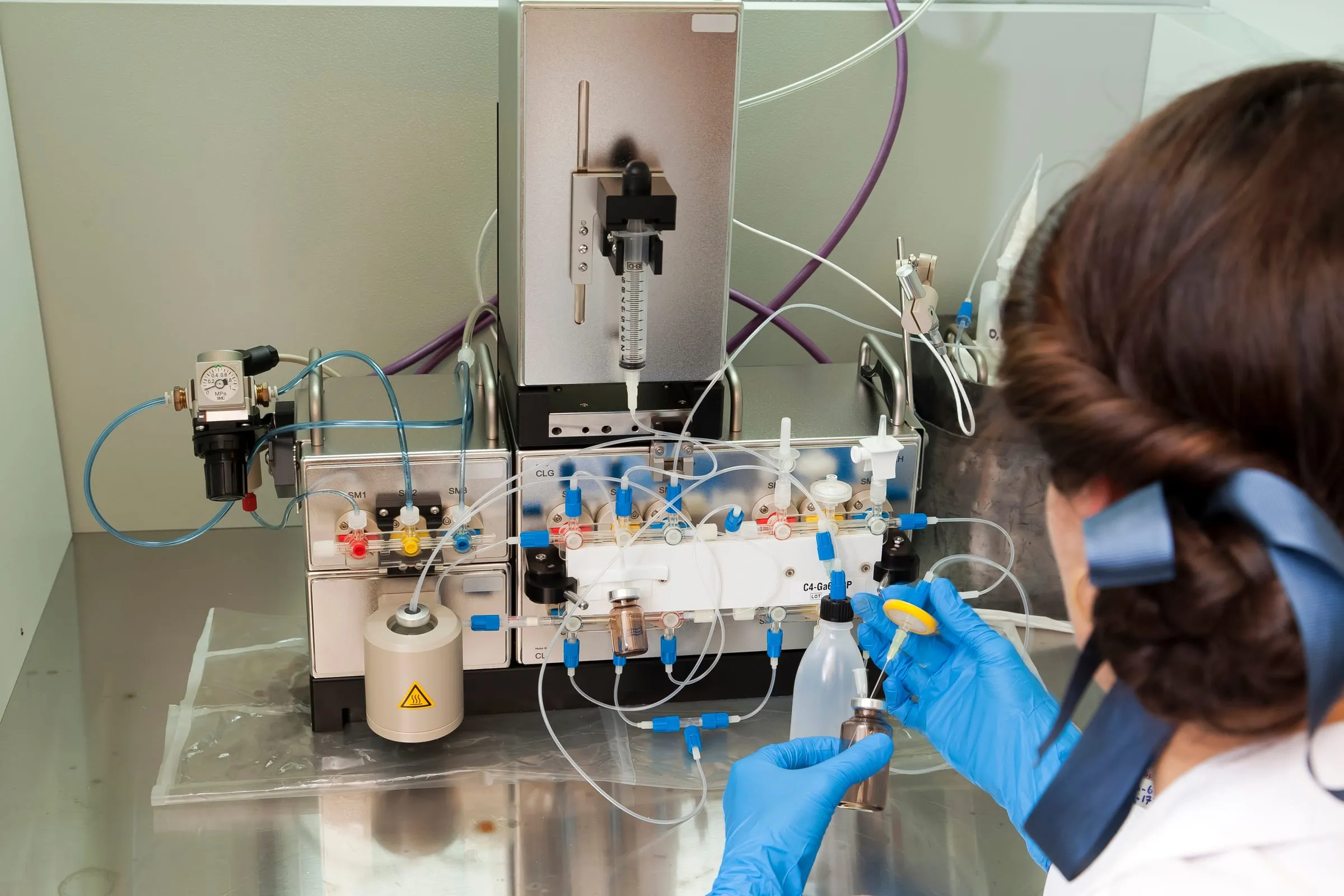
A gloved technician working at an automated radiopharmaceutical synthesis module in a laboratory — illustrative generic radiopharmacy, not a FabUTech or partner facility.

The hot-validation study

The validation that closes the loop.

Every quantitative claim on this site is modeled, built from a measured peroxide-clearance rate in DuraRad vials and published radiolysis yields. One assumption remains untested: that the immobilized enzymes keep clearing peroxide while the isotope is actively irradiating them. The radioactive validation study is designed to close exactly that gap.

This page describes the study's design and what is at stake, not results. Radioactive testing is scheduled for Q4 2026.

Modeled → proven

Does the coating still clear peroxide while the isotope is irradiating it?

Every number on this site is modeled from two real inputs: DuraRad's measured peroxide-clearance rate in coated vials, and published radiolysis yields for each isotope.

The model assumes the immobilized catalase keeps clearing peroxide at full strength while the vial sits under continuous irradiation. Cold-bench measurements already show the enzymes clearing spiked peroxide; whether they hold up inside a live radiation field is the open question.

The radioactive validation study closes that gap. It puts DuraRad-coated vials under real isotope decay and measures whether the enzymes survive and keep working, converting the model's single assumption into a measured result.

Measured · cold PoC measured

Peroxide, pipetted in

Cold proof-of-concept vial: peroxide added from outside A conceptual, illustrative diagram — not a modeled performance claim. A DuraRad-coated serum vial in cross-section: glass with a crimp flange and neck, a thin sol-gel film carrying immobilized enzymes lining the interior up to the base of the neck (the neck and flange are stopper-contact surfaces and stay uncoated; the real film is submicron, drawn thicker here so it stays visible), and solution filled partway up the body. A pipette above the open vial drips hydrogen peroxide down into it from outside — a heavier challenge than any isotope generates inside a drug vial, which is why this panel carries the larger population of marks; the added peroxide disperses where the droplet meets the fill line, diffuses through the solution, and is cleared to water and oxygen at its first touch of the coated interior — every mark converts, because this clearance was measured; a small chart beside the vial shows the measured fall over time. Compare the hot-test vial, where peroxide is instead generated inside the vial by live isotope decay and the conversion is the outcome under test.

The coating clears spiked H₂O₂, measured as it falls over time. That rate feeds every curve in the simulator.

0.107 min⁻¹ measured clearance rate (k)
The hot test outcome under test

Peroxide, made inside

Hot-test vial: peroxide generated inside by live decay A conceptual, illustrative diagram, not a measured result. The same DuraRad-coated serum vial — the same thin enzyme film lining the interior below the neck, the same solution, the same hydrogen peroxide molecule — but with a radioactive source submerged in the solution. As the source decays, peroxide is generated continuously near it, never added from outside, and diffuses through the solution: random motion drawn at figure scale, not aimed transport. Decay generates less peroxide than the cold vial's spiked challenge, so this panel carries fewer marks. The animation shows the mechanism under test: a mark converts to a teal mark, cleared to water and oxygen, at its first touch of the coated interior; because decay keeps generating, the population settles low but never empties — at any moment some marks are still in flight. Whether the immobilized enzymes really keep clearing peroxide under live decay is exactly what the radioactive study, designed and scheduled for Q4 2026, measures; the question mark stands for that outcome. Compare the cold vial, where the same clearing was measured with peroxide pipetted in from outside.

Live isotope decay generates H₂O₂ inside the vial. Do the immobilized enzymes keep clearing it?

Q4 2026
  • DuraRad film lining the interior below the neck
  • immobilized enzymes (catalase + Mn SOD)
  • H₂O₂ — pipetted in (cold) or generated by decay (hot)
  • cleared to water and oxygen — measured cold, under test hot
Conceptual. Cold studies added peroxide externally and measured the coating clearing all of it — the cold panel animates that measured clearance. The hot panel runs the same mechanism against peroxide generated continuously inside by live decay: the conversion drawn there is the outcome the radioactive study measures, not yet a measured result.

The cold clearance rate shown here is a real, measured bench result, not a model output. See the measured data on Evidence.

The study, in plain terms

Two of the field's toughest isotopes, one question: do the enzymes hold?

We fill DuraRad-coated vials (and matched uncoated control vials) with two of the most demanding therapeutic isotopes used in the clinic, let real radioactive decay irradiate the coating, and then measure whether the immobilized enzymes are still clearing peroxide.

One is Pb-212, an alpha-generating chain: a beta emitter whose short-lived daughters release intense, high-LET alpha energy inside the vial, the harshest radiolytic stress in therapeutic radiopharmacy. The other is Lu-177, the beta workhorse behind the highest-volume radioligand therapy on the market. Clearing the alpha chain is the strongest single case the coating can make; holding under Lu-177 is where the commercial volume lives.

What the study measures

01

Live suppression

Does the coating actually suppress radiolytic peroxide while the isotope is decaying, DuraRad-coated versus uncoated, measured across the full decay?

02

Enzyme survival

After a full end-of-life radiation dose, do the immobilized enzymes still clear peroxide, and how much of their original activity is retained?

03

Alpha vs beta

Does enzyme survival differ under an alpha-dominated, high-LET dose versus a low-LET beta dose, the two decay modes that dominate therapeutic radiopharmacy?

Why the design is rigorous

The alpha and beta arms are dosed to a matched cumulative radiation dose. That single choice turns the study into a controlled head-to-head: with total dose held equal, a difference in enzyme survival points to how the energy is deposited (an alpha-dominated, high-LET field versus a low-LET beta) rather than simply how much energy each isotope delivers.

Coated vials are always run against matched uncoated controls and fresh, unexposed reference vials measured the same day, so retained enzyme activity is read against a clean baseline rather than an absolute assumption.

The two isotopes, modeled

What the model predicts for the two study isotopes.

Here is what DuraRad's model projects for the exact two isotopes the study will test: an uncoated vial versus a DuraRad-coated vial at a representative clinical dose. The radioactive study will measure whether reality matches these curves.

Lead-212

Alpha-generating chain · high-LET stress case

Mixed chain

The harshest radiolytic insult in the study: a short-lived chain whose daughters deposit intense, high-LET alpha energy. Clearing it is the strongest single case the coating can make.

Modeled peroxide concentration over storage timeModeled hydrogen peroxide over 21.3 hours for Pb-212 at 175 MBq in a 10R/5 mL vial. The uncoated curve is a no-sink, no-scavenger upper bound; its peak is 181.6 µM, versus a DuraRad-coated peak of 2.75 µM. Modeled reduction in cumulative peroxide exposure 98.6 percent, which is not a measure of drug protected. Modeled from measured peroxide clearance in DuraRad vials and literature radiolysis yields. Radioactive validation designed and scheduled for Q4 2026 at Washington University in St. Louis.05010015020005.0101520Time (hours)[H₂O₂] (µM)UncoatedDuraRad

Scroll the chart

Modeled reduction in cumulative peroxide exposure

98.6 %

Not a measure of drug protected

Uncoated peak (upper bound)
181.6 µM
DuraRad peak
2.75 µM
Cumulative exposure (AUC)
2.37 mM·h0.033 mM·h −98.6% modeled
Modeled peak reduction
−98.5% 66x lower peak peroxide

Scenario: 175 MBq Pb-212 · 10R/5 mL · 21.3 hours window (two half-lives)

Modeled from measured peroxide clearance in DuraRad vials and literature radiolysis yields. Radioactive validation designed and scheduled for Q4 2026 at Washington University in St. Louis.

Model & validation detail

Pseudo-first-order H₂O₂ clearance, k = 0.107 min⁻¹ (Batch 2, 6R / 3.0 mL). Generation from literature G-values. Performance under continuous irradiation not yet validated.

Lutetium-177

Beta · commercial workhorse

Beta / positron

The beta isotope behind the highest-volume radioligand therapy, a long half-life that keeps generating peroxide for days, where the commercial volume lives.

Modeled peroxide concentration over storage timeModeled hydrogen peroxide over 13.3 days for Lu-177 at 7.4 GBq in a 10R/5 mL vial. The uncoated curve is a no-sink, no-scavenger upper bound; its peak is 1.59 mM, versus a DuraRad-coated peak of 1.69 µM. Modeled reduction in cumulative peroxide exposure 99.9 percent, which is not a measure of drug protected. Modeled from measured peroxide clearance in DuraRad vials and literature radiolysis yields. Radioactive validation designed and scheduled for Q4 2026 at Washington University in St. Louis.05001k1.5k2k02.55.07.51013Time (days)[H₂O₂] (µM)UncoatedDuraRad

Scroll the chart

Modeled reduction in cumulative peroxide exposure

99.9 %

Not a measure of drug protected

Uncoated peak (upper bound)
1.59 mM
DuraRad peak
1.69 µM
Cumulative exposure (AUC)
311.3 mM·h0.293 mM·h −99.9% modeled
Modeled peak reduction
−99.9% 944x lower peak peroxide

Scenario: 7.4 GBq Lu-177 · 10R/5 mL · 13.3 days window (two half-lives)

Modeled from measured peroxide clearance in DuraRad vials and literature radiolysis yields. Radioactive validation designed and scheduled for Q4 2026 at Washington University in St. Louis.

Model & validation detail

Pseudo-first-order H₂O₂ clearance, k = 0.107 min⁻¹ (Batch 2, 6R / 3.0 mL). Generation from literature G-values. Performance under continuous irradiation not yet validated.

Where the study stands

Protocol finalized. Next stop: the hot lab.

The analytical protocol is complete and study pre-work is getting underway. Radioactive validation is scheduled for Q4 2026.

  1. Protocol finalized completed
  2. Study pre-work in progress initiating
  3. Radioactive validation upcoming scheduled Q4 2026
With the laboratory of Dr. Daniel Thorek at the Mallinckrodt Institute of Radiology, Washington University School of Medicine in St. Louis.

Follow the milestone

Be there when modeled becomes proven.

The radioactive validation is the de-risking milestone for DuraRad. Follow along to hear the moment the results land, or go deeper into the science now.

Be first to know.

Get a short note when the validation study reaches its milestones. No noise, just the science as it de-risks.