The field
Radiopharmaceuticals, explained.
A new generation of cancer medicines delivers radiation straight to the tumor. They are precise, already approved, and growing fast. Yet all of them share one hard constraint that decides whether they scale.
What they are
Targeted, not systemic.
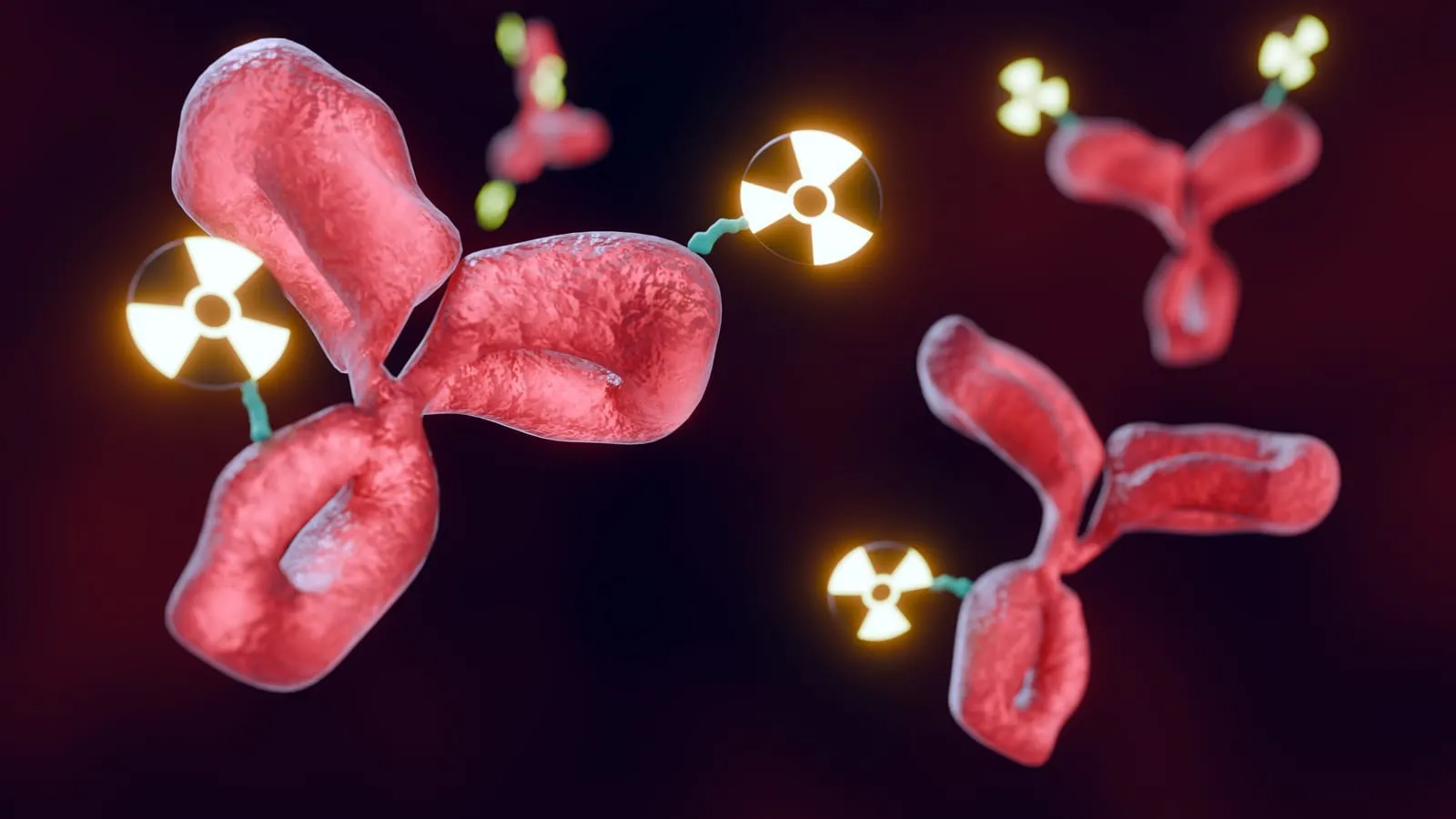
A radiopharmaceutical is a medicine that carries a radioactive atom into the body. In cancer, the most important kind is radioligand therapy: a targeting molecule that homes in on a marker on cancer cells is chemically linked to a radioactive isotope, so the radiation is delivered to the tumor while most healthy tissue is spared.
Because the radiation is aimed at a molecular target rather than a region, it can reach cancer wherever it has spread. That precision is why analysts rank it among oncology’s fastest-growing segments.
Theranostics
See it, then treat it.
The powerful twist is the theranostic pair. Put a diagnostic isotope on the targeting molecule and take a PET scan to see exactly where the disease is and whether the target is even present. Then put a therapeutic isotope on the same molecule and treat it. Diagnosis and therapy, matched on one address.
Image with gallium-68
A PET tracer lights up the tumor and confirms the target is there, so treatment is chosen for the patients it can actually help.
Treat with lutetium-177
The same targeting molecule now carries a therapeutic isotope to deliver its dose to those exact sites.
Lutetium-177
A beta (electron) emitter. Its particles travel a millimeter or two, giving a broad, relatively even dose across a tumor and its neighbors. The workhorse behind Lutathera and Pluvicto.
Actinium-225 · Lead-212
Alpha emitters stop within a few cell-widths and deposit intense, clustered damage right at the target. Roughly a few hundred times the local hitting power of a beta, and the focus of the newest pipelines.
Lead-212 is technically a beta emitter whose radioactive daughters deliver the therapeutic alpha particles. Range and energy figures are approximate and vary by decay pathway.
Already in the clinic
The first radiopharmaceutical was approved in 1951, and it is still standard of care.
Targeted radiopharmaceuticals have been approved and treating patients for decades, and the pace is accelerating.
- 1951
Iodine-131
The first FDA-approved radiopharmaceutical, and a theranostic in its own right: radioiodine both images and treats thyroid tissue. Still standard of care today.
- 2013
Xofigo (radium-223)
The first alpha-emitting therapeutic approved, for prostate-cancer bone metastases, on a proven overall-survival benefit.
- 2018
Lutathera (Lu-177)
The first modern peptide-receptor radioligand therapy approved by the FDA, for neuroendocrine tumors.
- 2022
Pluvicto (Lu-177)
PSMA-targeted therapy for advanced prostate cancer. In the VISION trial it extended median overall survival to 15.3 months, versus 11.3 with standard care alone.
Trial results describe those specific drugs under defined eligibility; they are not outcomes for any individual, and not claims about DuraRad.
The inflection point
Big pharma has already placed its bets.
Commercial proof set off a buying spree. In roughly six years, four of the largest drugmakers committed nearly fourteen billion dollars in disclosed radiopharmaceutical acquisitions.
~$14B
Disclosed radiopharma acquisitions by four of the largest drugmakers in about six years
Novartis, Lilly, BMS, AstraZeneca
~$2B
Pluvicto full-year 2025 sales, up ~42%
Nuclear medicine’s first blockbuster (Novartis FY2025)
$15–22B
Projected radiopharmaceutical market by the early-to-mid 2030s
from ~$6–8B mid-2020s; third-party analyst range
- Novartis Advanced Accelerator Applications (Lutathera) ~$3.9B, 2018
- Novartis Endocyte (PSMA-617 → Pluvicto) ~$2.1B, 2018
- Eli Lilly POINT Biopharma ~$1.4B, 2023
- Bristol Myers Squibb RayzeBio (actinium-225 platform) ~$4.1B, 2024
- AstraZeneca Fusion Pharmaceuticals up to ~$2.4B, 2024
Market-size figures are third-party analyst projections; base years, scope, and methodology differ by firm, so estimates vary widely. Deal values are as announced. See sources below.
Why it is hard to scale
The science works. The logistics are the frontier.
When Pluvicto went into an eight-month FDA-recognized shortage in 2023, driven partly by relying on a single manufacturing site, new patients faced waits of three months or more, and physicians publicly warned that some would not make it. The molecule was never the constraint. A short shelf life and constrained supply were.
That is why stability, packaging, and supply chain are strategic. Anything that keeps a dose pure and potent for longer widens the delivery radius, reduces waste, and de-risks scaling the whole field.
-
It is decaying before it ships
Lutetium-177 loses half its strength about every 6.6 days; gallium-68, about every 68 minutes. You cannot warehouse a radioligand. Each dose is made to order for a named patient and raced to the clinic.
-
Production is central, patients are everywhere
Isotopes come from a handful of specialized reactors and plants, while patients are spread across a country. Distance and delivery time are limited by physics, not shipping schedules.
-
The vial damages its own contents
The dose’s own radiation splits water into reactive oxygen species throughout the solution. Those species diffuse at random, and some reach and oxidize the targeting molecule, lowering radiochemical purity during the very window the dose must survive. Higher activities and antibody-based drugs make this self-damage worse.
-
Where DuraRad fits
DuraRad is FabUTech’s bet on that last problem: a sol-gel coating on the inside of the vial that carries enzymes (catalase and manganese SOD) to lower the standing concentration of the reactive species that decay creates. The hypothesis is more usable life per dose. It is pre-validation, so that benefit is a rationale we are testing, not a proven result.
DuraRad is infrastructure for this moment.
See the supply-chain clock the field is racing, how the coating is designed to answer it, or the measured result behind the model.
Sources
Approvals, deals, and sales are public and cited here. Market projections are third-party analyst estimates. Facts describe the named drugs and companies, not DuraRad.
- FDA — Lutathera (Lu-177 dotatate) approval, 2018
- FDA approval summary — Pluvicto (Lu-177 vipivotide tetraxetan), 2022
- Novartis FY2025 results (Pluvicto / Lutathera sales)
- BMS completes acquisition of RayzeBio (actinium-225), 2024
- Radiolysis and radiochemical-purity loss (Molecules, 2023)
- Radiopharmaceuticals market forecast (Allied Market Research)