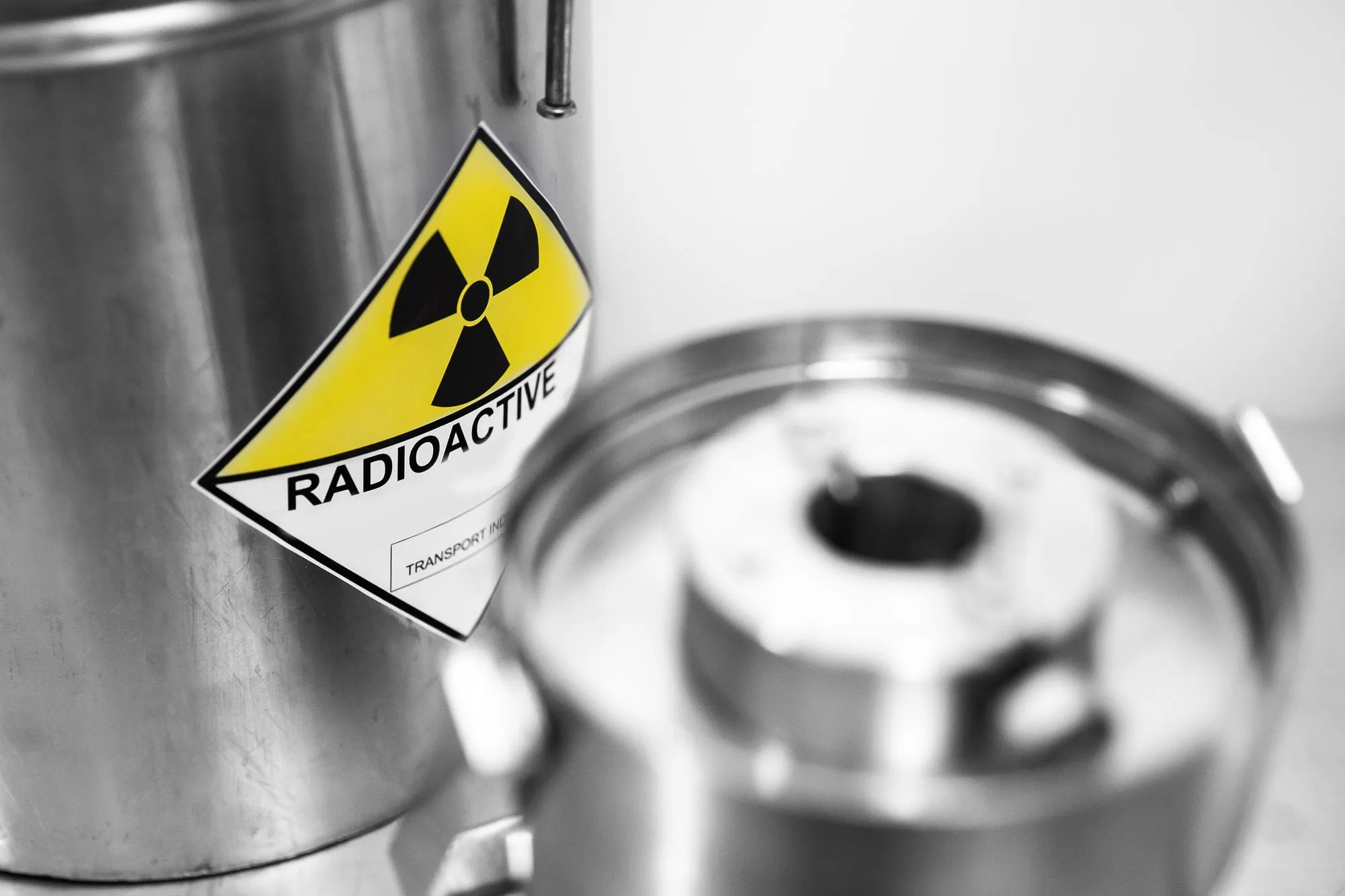
The problem
Every dose is racing a clock it cannot reset.
A radiopharmaceutical is manufactured to order, one patient at a time, and the moment it exists it begins to expire. Physical decay sets the deadline. Radiolysis, the drug irradiating itself, moves the deadline up. Whatever the clock takes never reaches the patient.
Every fact about the problem on this page is public and cited below. The stage-by-stage supply-chain timing is illustrative; the half-life, the shelf-life window, and the decay figures are exact, sourced numbers.
Two clocks
Two clocks run against every dose.
Unlike an ordinary drug, a radiopharmaceutical cannot be made in advance, warehoused, or reordered overnight. Its active ingredient is a decaying isotope. The inventory is disappearing the whole time it sits. Two clocks run from the instant of manufacture, and neither can be paused.
Radioactive decay
The isotope decays on a fixed half-life. For lutetium-177, the most-used therapeutic radionuclide after iodine-131, that is 6.647 days. Half the activity is gone in under a week, no matter what anyone does. This clock is pure physics, and no coating changes it.
Radiolysis
The same radiation that treats the patient also attacks the drug in the vial, generating reactive oxygen species that oxidize the molecule and drop its radiochemical purity below the release spec. This clock is the one chemistry can slow, and the one DuraRad targets.
The dose journey
Follow one vial from synthesis to patient.
Drag across the timeline to walk a single Lu-177 dose from synthesis to patient, across the five-day window over which a product like Pluvicto is actually administered. Two things fall as it travels: usable activity (fixed physics) and radiochemical purity (the addressable clock). By the time it reaches the patient there is still activity to spare: it is purity that runs out first, and that is the limit DuraRad is built to push back.
- 01 · Manufacture +0 h
Radiolabeling, formulation & aseptic fill
100% usable activity · Day 1
99.5% radiochemical purity · spec ≥ 95%
The dose is built to order and goes straight into its final container. The half-life clock starts the instant the drug exists. There is no shelf stock to draw from.
- 02 · Release +18 h
Quality control & release
92% usable activity · Day 1
98.7% radiochemical purity · spec ≥ 95%
Identity, radionuclidic and radiochemical purity are confirmed on the filled and sealed vial before anything can ship. Every hour of testing is an hour of decay.
- 03 · Shipment +30 h
Shielding, labeling & dispatch
88% usable activity · Day 2
98.2% radiochemical purity · spec ≥ 95%
Shielded, labeled with a calibration time, and handed to a courier. The batch leaves the only site that can make it.
- 04 · Transit +66 h
Courier & transit
75% usable activity · Day 3
96.8% radiochemical purity · spec ≥ 95%
Flights and vans that cannot be rushed. Decay and radiolysis both work the entire trip, and the dose can never be replenished en route.
- 05 · Receipt +96 h
Clinic receipt & prep
66% usable activity · Day 5
95.8% radiochemical purity · spec ≥ 95%
Received, assayed against the calibration, and prepared for administration. Days have passed. There is still plenty of usable activity, but radiochemical purity has drifted close to the release spec.
- 06 · Administration +120 h
Patient administration
59% usable activity · Day 5
95.2% radiochemical purity · spec ≥ 95%
The dose is given with usable activity to spare, yet purity, not potency, is what closes the window, right about now. Hold purity in spec longer and the same batch could reach farther.
Illustrative shelf-life view. Elapsed time and usable activity are exact Lu-177 decay (t½ 6.647 d); the purity curves are illustrative, using the cited exponential form (Molecules 2023) and not yet validated under live irradiation. "Purity today" represents a stabilized commercial dose, which is why it holds in spec to administration; an unstabilized preparation degrades far faster (97%→43% in 6 h; see The stakes). Stage timings are representative.
- Purity today
- Purity with DuraRad
- 95% release spec
- Manufacture — Radiolabeling, formulation & aseptic fill: The dose is built to order and goes straight into its final container. The half-life clock starts the instant the drug exists. There is no shelf stock to draw from. (100% usable activity, 99.5% radiochemical purity).
- Release — Quality control & release: Identity, radionuclidic and radiochemical purity are confirmed on the filled and sealed vial before anything can ship. Every hour of testing is an hour of decay. (92% usable activity, 98.7% radiochemical purity).
- Shipment — Shielding, labeling & dispatch: Shielded, labeled with a calibration time, and handed to a courier. The batch leaves the only site that can make it. (88% usable activity, 98.2% radiochemical purity).
- Transit — Courier & transit: Flights and vans that cannot be rushed. Decay and radiolysis both work the entire trip, and the dose can never be replenished en route. (75% usable activity, 96.8% radiochemical purity).
- Receipt — Clinic receipt & prep: Received, assayed against the calibration, and prepared for administration. Days have passed. There is still plenty of usable activity, but radiochemical purity has drifted close to the release spec. (66% usable activity, 95.8% radiochemical purity).
- Administration — Patient administration: The dose is given with usable activity to spare, yet purity, not potency, is what closes the window, right about now. Hold purity in spec longer and the same batch could reach farther. (59% usable activity, 95.2% radiochemical purity).
Illustrative shelf-life view. Elapsed time and usable activity are exact Lu-177 decay (t½ 6.647 d); the purity curves are illustrative, using the cited exponential form (Molecules 2023) and not yet validated under live irradiation. "Purity today" represents a stabilized commercial dose, which is why it holds in spec to administration; an unstabilized preparation degrades far faster (97%→43% in 6 h; see The stakes). Stage timings are representative.
The stakes
Pluvicto: five days, no slack.
Radioligand therapy is one of oncology's fastest-growing modalities. Its leading Lu-177 product, Pluvicto, carries a labeled shelf life of just 120 hours, five days from calibration to expiry. That is the entire window to test, release, ship, receive, and inject a product that is decaying the whole time. Across those five days, physical decay alone removes a large share of the starting activity, before radiolysis is even counted.
Radiolysis is the compounding blow, and it is fast. An unstabilized, clinical-strength Lu-177 preparation has been measured falling from 97% radiochemical purity to 43% in six hours, straight through the 95% release spec. A vial that drifts out of spec is lost; it cannot be remade in time for that appointment. That is why every dose already carries chemical stabilizers against radiolysis, and why there is room to slow that decline further.
41%
of a Pluvicto dose's starting Lu-177 activity is gone to decay alone across its labeled 120 h window — before radiolysis
Exact Lu-177 decay across a 120 h window · t½ 6.647 d
The turn
DuraRad gives the addressable clock back.
Decay is fixed physics. No one can change a half-life. Radiolysis is different: it is a chemistry problem, and chemistry can answer it. DuraRad bonds an active enzyme coating to the inside of the vial that consumes reactive oxygen species at the wall, lowering their steady-state concentration throughout the solution. Because it is a fixed feature of the container rather than another additive in the fill, it adds margin alongside the chemical stabilizers a dose already carries, rather than replacing them.
That does not stop the decay clock. It slows the one that engineering can, and on this page the benefit is qualitative by design. The quantified, physics-grounded version lives in the interactive model.
Holds the line
Purity held closer to spec for more of the usable window means fewer doses drifting below release spec in transit.
More doses delivered
Fewer vials scrapped for out-of-spec purity, so more of what was made actually reaches a patient.
Same batch, farther
A longer in-spec window is a longer reach: the same production run can serve clinics too far to reach in time today.
The reach
Time recovered is reach recovered.
The doses that expire in transit are the doses that never reach a patient. Every hour radiolysis takes narrows the ring of clinics a single production run can serve in time, and strands more of the batch past spec before it arrives.
Slow that addressable clock and the ring widens. The same batch, made in the same place, serves clinics that are out of reach today. That is what the whole problem comes down to.

- Production
- Reach today
- Reach with DuraRad
See it quantified
Watch the two clocks — and DuraRad's answer.
The interactive model puts real numbers on everything above: pick a clinical dose and watch peroxide build in an uncoated vial and a DuraRad-coated vial hold it far lower, across the full modeled storage window.
Sources
Public, citable references for the facts on this page. DuraRad's own performance is modeled and not yet validated. See the interactive model and Evidence for its status.
- Lu-177 half-life 6.647 d — Developments in 177Lu radiopharmaceutical therapy, Frontiers in Chemistry (2023)
- Lu-177 β⁻ decay to stable Hf-177 — Dash et al., Production of 177Lu, PMC (2015)
- Lu-177 the most-used therapeutic radionuclide after I-131 — targeted-therapy review, PMC (2021)
- Pluvicto 7.4 GBq dosing and 120-hour shelf life — FDA Prescribing Information (DailyMed)
- Pluvicto 7,400 MBq posology — Summary of Product Characteristics (emc)
- Radiolysis lowers radiochemical purity (97%→43% in 6 h); 95% release spec — Molecules (2023)
- Radiopharma cannot be stockpiled; logistics is the access bottleneck — BioSpace
- Supply chains built around fast-decaying products — BioSpace
- Radiotherapeutics supply-chain complexity — pharmaphorum / L.E.K. Consulting