You can watch it happen
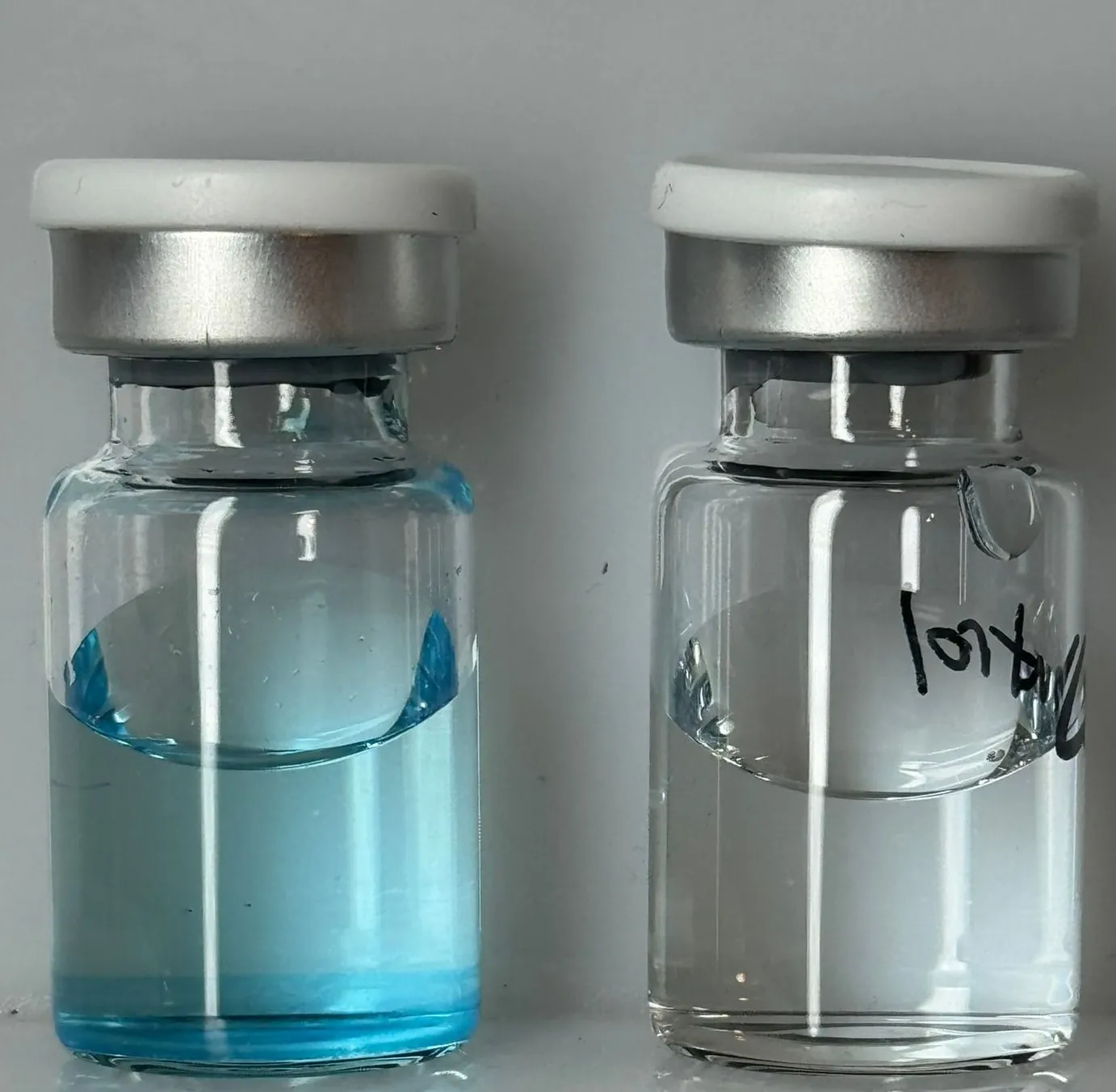
A methylene-blue redox test: the coated vial drives a visible color change the uncoated control does not. A qualitative bench demonstration of catalytic activity — not the product, its coating, or its color.
Evidence and development
It is in active development, and this page draws the same line a diligence team would: what is established, and what is underway.
A pre-commercial platform is worth what it has de-risked. DuraRad rests on three independent measured results: a peroxide-clearance rate, durability across repeated challenges without wearing out, and retained activity after dry storage. Behind them sit filed provisional applications, demonstrated proof of concept, and a radioactive validation study designed and scheduled. The proof-of-concept data is shown here in full; what stays private is the coating's composition and how it is made.
Measured result
k = 0.107 per minute
Pseudo-first-order hydrogen peroxide clearance rate constant
Batch 2 fit · 6R vial · 3.0 mL fill
t½ 6.5 min
Clearance half-life, t½ = ln2 / k
In plain terms: the coating clears about half of the added peroxide every 6 to 7 minutes, and roughly 90 percent of it within about 20 minutes.
Measured pseudo-first-order hydrogen peroxide clearance in DuraRad-coated vials, fitted on the Batch 2 challenge (6R / 3.0 mL). Curve shown: a Batch 4 vial, which clears faster; the model uses the Batch 2 fit. A cold-chemistry bench result. Clearance under continuous irradiation is the subject of the scheduled validation study.
DuraRad's coating immobilizes two enzymes on the vial wall. Radiolysis generates short-lived reactive oxygen species, including hydroxyl and superoxide radicals; what persists and accumulates over a dose's shelf life is hydrogen peroxide, the stable oxidant they leave behind. Manganese superoxide dismutase converts radiolytic superoxide to hydrogen peroxide and oxygen, and immobilized catalase decomposes that hydrogen peroxide to water and oxygen, so the coating lowers the steady-state concentration across the coupled superoxide-and-peroxide cascade rather than acting on peroxide in isolation. On the bench, we spiked coated vials with hydrogen peroxide and tracked how quickly the immobilized catalase cleared it. Because the enzyme loading in the coating is fixed, the clearance follows pseudo-first-order kinetics, with a rate constant of k = 0.107 per minute.
This is the measured input the interactive model runs on. It is a cold-chemistry result: the coating clearing peroxide added by pipette, not peroxide generated by live radioactive decay. Whether that clearance holds while an isotope irradiates the enzymes is exactly what the validation study is built to test.
The bench proof
The same enzyme coating, tested three ways on the bench. You can watch it work, it clears repeated challenges without wearing out, and it still works after storage.
You can watch it happen
A methylene-blue redox test: the coated vial drives a visible color change the uncoated control does not. A qualitative bench demonstration of catalytic activity — not the product, its coating, or its color.
It doesn't wear out
Clear the vial, refill it with fresh peroxide, and it clears the second dose just like the first. The immobilized catalase is a catalyst — it is not consumed as it works.
It survives storage
A vial stored five days empty and dry still clears a fresh challenge on the same curve as a fresh one. The activity is built into the wall, and it stays there.
Measured cold-bench data (Batch 2, 6R / 3.0 mL). A cold-chemistry result, not a performance claim under live irradiation — that is what the validation study tests.
Where DuraRad stands
Each step converts an assumption into a result. Two are behind us, the third is being prepared, and the study that bridges modeled to proven is designed and scheduled.
Filed provisional applications cover the coating chemistry, the enzyme immobilization, and their application to pharmaceutical containers. An international (PCT) filing is planned.
Bench proof of concept has demonstrated the coating's core function: the immobilized enzymes stay active on the wall and clear hydrogen peroxide from solution. The measured clearance rate is the headline; the same coating also clears repeated peroxide challenges without wearing out, and still works after storage, all shown above.
DuraRad's regulatory strategy runs through container closure, not reformulation: it is being developed and positioned as a container closure system component under 21 CFR 211.94, assessed as primary packaging against established expectations rather than as a new device review pathway. Because the scavenger enzymes are immobilized in the bonded silica matrix by design, rather than dissolved in the fill, an extractables and leachables assessment is part of the container-closure qualification. We have submitted a pre-RFD to FDA's Office of Combination Products for the agency's early read on how the product should be classified.
The hot-validation protocol is finalized. DuraRad-coated vials will be irradiated with Pb-212 and Lu-177 to measure enzyme activity retention under live decay, in Dr. Daniel Thorek's laboratory at Washington University's Mallinckrodt Institute of Radiology. Radioactive testing is scheduled for Q4 2026; results will be reported once available and confirmed.
The proof-of-concept data is on this page, in full. What is held back is the coating's composition and production process, which are not disclosed to anyone, and unfiled next-generation work, which is described under appropriate terms in the data package. Validation data will be reported once the radioactive study reads out.
The data package includes the technical detail appropriate to a diligence conversation.