Isotope profile
Actinium-225
Ac-225 · Actinium
Actinium-225 is the leading targeted-alpha isotope: four alpha emissions per decay make it the densest radiolytic source in the clinic, and it does so from a dose of only single-digit megabecquerels.
Public data & model inputs
Alpha / high-LET- Half-life
- 9.92 days
- Decay mode
- α chain
- Charged-particle energy per decay
- 27.6 MeV
- G(H₂O₂) yield
- 1.10
- Clinical use
- Targeted alpha therapy (TAT)
NNDC updated the Ac-225 half-life to 9.92 d; the model curve uses the legacy 10.0 d value, a difference invisible on the illustrative fingerprint.
The radiolytic profile
Why Ac-225 is hard
Ac-225 does not decay once; it opens a four-alpha chain, releasing on the order of 27 MeV of charged-particle energy per parent decay. Alpha particles are high-LET: they deposit that energy in dense, short ionization tracks, and the peroxide yield per unit energy (G) rises with ionization density. Decay for decay, Ac-225 is the most radiolytically intense isotope in the clinical roster.
What sets it apart is intensity, not bulk activity. Targeted-alpha doses are administered in single-digit megabecquerels, not the gigabecquerels of a beta therapy, roughly a thousandfold less activity. Yet the roughly 27 MeV each parent decay deposits across its four-alpha chain is so radiolytically productive that the modeled peroxide still climbs into the hundreds of micromolar, within range of the gigabecquerel beta therapeutics rather than far below them. The roughly 10-day half-life then holds that burden across a long clock. Ac-225's story is intensity per decay carried over a long clock, not large administered activity.
The high-LET peroxide behavior is drawn from the radiation-chemistry literature (Pastina & LaVerne), which documents how hydrogen-peroxide yield increases as ionization density rises: the reason an alpha emitter is modeled with a higher yield than a beta of the same energy.
The modeled run
One clinical scenario, uncoated vs DuraRad
The run below models a representative targeted-alpha vial across two half-lives, uncoated and then with a DuraRad coating on the same geometry, so the coating is the only variable that changes.
Scenario: 8 MBq Ac-225 · 10R/5 mL vial · 20.0 days window (two half-lives)
Scroll the chart
Modeled reduction in cumulative peroxide exposure
99.9%
Not a measure of drug protected
- Uncoated peak (upper bound)
- 754.1 µM
- DuraRad peak [H₂O₂]
- 531.9 nM
- Cumulative exposure (AUC)
- 221.5 mM·h → 0.139 mM·h −99.9% modeled
- Modeled peak reduction
- −99.9% 1.4kx lower peak peroxide
Modeled from measured peroxide clearance in DuraRad vials and literature radiolysis yields. Radioactive validation designed and scheduled for Q4 2026 at Washington University in St. Louis.
Model & validation detail
Pseudo-first-order H₂O₂ clearance, k = 0.107 min⁻¹ (Batch 2, 6R / 3.0 mL). Generation from literature G-values. Performance under continuous irradiation not yet validated.
The DuraRad answer
How DuraRad protects this product
DuraRad lines the vial wall with a sol-gel coating that holds two immobilized enzymes: manganese superoxide dismutase, which converts superoxide into hydrogen peroxide and oxygen, and catalase, which breaks that hydrogen peroxide down into water and oxygen. Radiolysis of the water generates reactive oxygen throughout the dose, at random positions and in every direction; the coating acts as a distributed sink at the wall, consuming the superoxide and peroxide that diffuse to it and lowering their steady-state concentration in the vial. Because the enzymes are fixed in the coating rather than dissolved in the dose, they work without becoming an additive in a product already dispensed at trace mass. Clearing the superoxide and peroxide the alpha tracks produce keeps their concentration low and lowers the oxidative burden on the radiolabeled molecule.
Ac-225's oxidative burden is unusual: extraordinarily intense per decay, because a four-alpha chain lays down dense, high-LET ionization tracks with a high peroxide yield, from an administered activity of only single-digit megabecquerels, a thousandfold below a beta therapy. The near-10-day half-life then sustains that intense production across a long clock, so the modeled peroxide accumulates into the hundreds of micromolar before the source fades. Enzymatic clearance runs on a timescale of minutes, far faster than Ac-225 generates peroxide, so the wall sink keeps pace easily and the model holds peroxide well below the uncoated level across the window. The modeled proportional suppression is large: the value here is lowering the intense per-decay reactive oxygen the dense alpha tracks produce and reducing the load on the radiolabeled product. The Q4 2026 radioactive validation at Washington University in St. Louis is designed to confirm this modeled behavior.
Where it's going
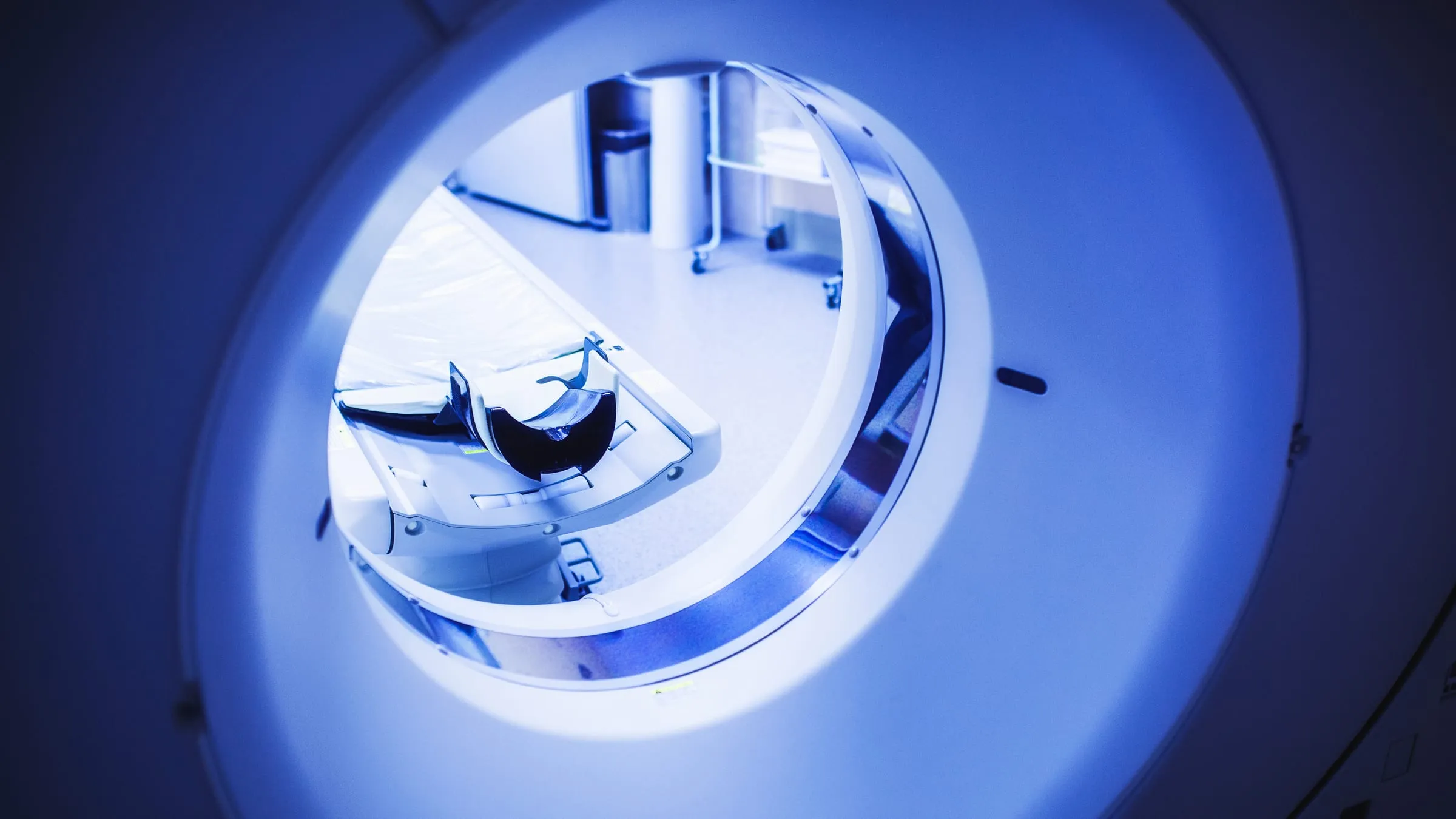
Every Ac-225 dose is headed for a scanner or a treatment room, where arriving intact is the whole point.
Data & sources
Sources for this isotope
- Pastina & LaVerne, J. Phys. Chem. A (1999) LET dependence of hydrogen-peroxide yield in water radiolysis.
The full nuclear-data citation list for the roster is on the isotope index.
Keep exploring
More of the roster
Model Actinium-225 against your own dose.
Open the simulator pre-loaded with Ac-225 and adjust activity, vial format, and fill volume, reserve coated vials to test on your own bench, or talk to us about your product.